

 Log in

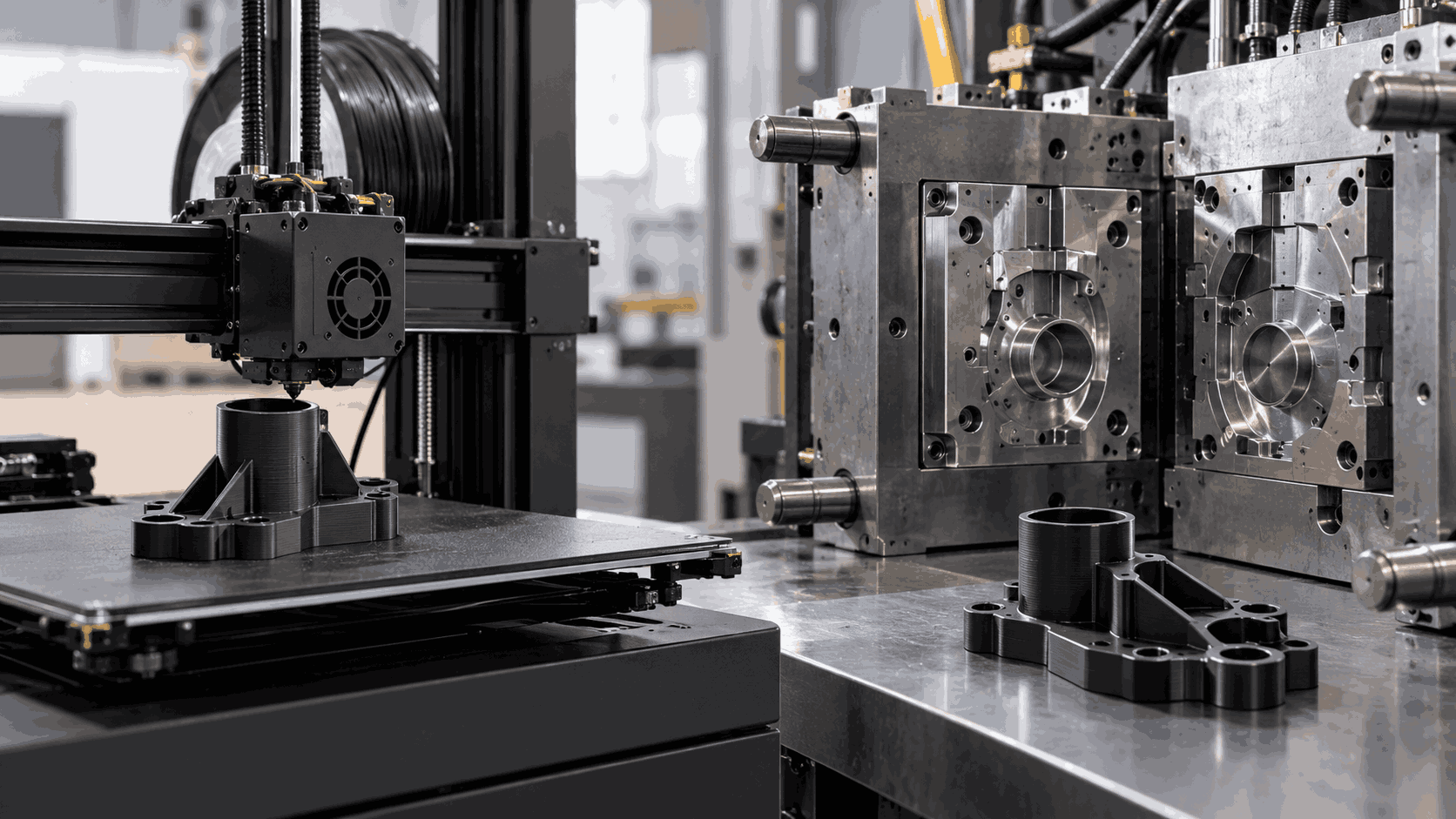
When there is a need to manufacture a plastic part, the choice of technology affects more than just the cost of the first sample. It determines dimensional accuracy, strength, consistency of properties, production lead times, and the unit cost of future batches.
3D printing is convenient for design validation and producing individual samples, while plastic injection molding is generally more suitable for repetitive series production. This is especially true when a part needs to perform consistently under load, meet specified requirements, and be manufactured in significant quantities.
However, the final decision depends on the material, design, operating conditions, and planned production volume. Let's examine what to consider before launching a project.
Why Technology Affects Project Profitability
Comparing only the price of a single part is not enough. It is important to consider production setup costs, materials, potential design changes, manufacturing time, and the total number of products the company plans to produce.
A method that allows one prototype to be manufactured quickly will not necessarily be optimal for regular batch production. Conversely, investing in an injection mold requires justification if the design is still changing or the production volume remains uncertain.
Therefore, the first step is to define the project's objective: validate an idea, produce a small batch, or prepare for stable series production.
3D Printing: A Tool for Prototyping and Concept Validation
3D printing creates a part from a digital model without the need to manufacture an industrial injection mold. This makes it possible to check geometry, fit, compatibility with other components, and make design changes during the development stage.
This approach can be useful for individual samples and small batches if the properties of the printed part meet the specified requirements. However, mechanical properties, high precision, and surface quality depend on the specific printing technology, material, and equipment settings.
Plastic Injection Molding: Advantages for Series Production
Plastic injection molding is a manufacturing process in which molten polymer is injected into a mold, takes the required shape, cools, and is ejected as a finished part. The cycle then repeats.
It is this process repeatability that makes injection molding one of the main methods of manufacturing plastic products in series. With a properly prepared design and stable production parameters, the technology ensures precise geometry, complex structural features, high productivity, and consistent part properties.
For the customer, this means the ability not only to obtain a sample but also to organize predictable production of products that meet specified technical requirements. As production volumes increase, the cost of the injection mold is distributed across a larger number of parts, which can make injection molding more economically attractive than producing individual items.
Another important advantage is the ability to select polymers according to the specific application. AMMOLIT PLUS works with polyamide, polypropylene, ABS, polyurethane, and other engineering plastics. Materials are selected based on strength, flexibility, weight, temperature resistance, wear resistance, and operating conditions.
Can Injection-Molded Parts Really Be Stronger Than 3D-Printed Parts?
Yes, in many practical cases, injection molding offers advantages in terms of structural uniformity and the consistency of mechanical properties. Unlike some layer-by-layer 3D printing methods, an injection-molded part does not have the characteristic boundaries between printed layers that can reduce strength in certain directions.
This is particularly important for fasteners, functional elements, and components subjected to loads or repeated mechanical stress. At the same time, it would be incorrect to claim that every injection-molded product is always stronger than every 3D-printed product. The result depends on the polymer, geometry, specific printing method, and molding parameters.
If strength and durability are critical, the final decision should be confirmed through testing of samples manufactured using the planned series production technology.
Comparison of 3D Printing and Injection Molding
| Criterion | 3D Printing | Injection Molding |
|---|---|---|
| Main purpose | Prototypes, individual samples, small batches | Repetitive series production |
| Injection mold | Not required | Required to start series production |
| Design changes | Usually easier before production begins | May require mold modifications after manufacturing |
| Mechanical properties | Depend on the method, material, and print orientation | Depend on the polymer, design, and molding parameters |
| Repeatability | Depends on equipment and the process | High with a stable manufacturing process |
| Production economics | No initial investment in an industrial mold | Mold costs are distributed across the production batch |
| Scalability | Depends on printing time and the number of machines | Suitable for regular series production |
When Do Injection Mold Costs Become Justified?
It is common to encounter guidelines such as "3D printing for up to 500 parts" or "injection molding starting from 1,000 units." However, there is no universal threshold. The same production quantity can have different economics depending on part dimensions, geometric complexity, material, mold service life, and required additional operations.
To assess whether switching to injection molding is worthwhile, the initial tooling costs must be compared with the expected unit cost of parts in series production. It is important to consider not only the first order but also subsequent batches. If the product is intended for regular production, the economic outcome can change significantly.
Therefore, instead of relying on an arbitrary "magic number," it is better to perform calculations for a specific part, taking into account its material, design, and projected production volume.
A Hybrid Approach to Plastic Product Manufacturing: Prototyping for Validation, Injection Molding for Series Production
3D printing and injection molding do not necessarily compete with each other. At different stages of the same project, they can serve different purposes: first, the geometry or assembly of a prototype is tested, then the design is refined, an injection mold is designed, and test injection-molded samples are produced.
Once the samples have been tested and approved, series production can begin. This sequence helps avoid premature modifications to already manufactured tooling. At the same time, testing a 3D-printed prototype does not replace testing an injection-molded part when actual operating loads are involved.
What to Check Before Choosing a Technology
- The part's intended purpose and operating conditions: loads, temperature, friction, and wear.
- Geometry, required accuracy, and compatibility with other components.
- Material and critical mechanical properties.
- Planned production volume, frequency of repeat batches, and projected volume growth.
- Design readiness: whether testing has been completed and whether changes are still possible.
The more precisely these parameters are defined, the more thoroughly different methods of manufacturing plastic products can be compared and a technical and economic assessment prepared.
Series Injection Molding and Mold Manufacturing at AMMOLIT PLUS
AMMOLIT PLUS manufactures custom plastic products through a complete production cycle: technical specification analysis, design, material selection, injection mold manufacturing, sample testing, and series injection molding.
An in-house design department and mold manufacturing capabilities make it possible to consider part requirements even before series production begins. This is important for the customer because product design, tooling, and injection molding technology are directly interconnected.
3D printing helps validate ideas and manufacture individual samples. Injection molding is one of the main solutions for series production when repeatability, precision, productivity, and control over part properties are important.
When choosing a technology, it is worth evaluating not only the number of products but also the design, material, operating conditions, and overall economics of future series production. This approach helps make a well-founded manufacturing decision.
catalog.faq_title
At What Production Volume Is It Worth Switching from 3D Printing to Injection Molding?
There is no single threshold. Economic feasibility depends on the cost of the injection mold, the unit cost of parts, design, material, and total projected production volume.
Are 3D-Printed Parts Weaker Than Injection-Molded Parts?
Sometimes, especially with layer-by-layer printing, where the bonds between layers may be weaker under certain loads. However, properties must be compared for specific materials and technologies, and critical components should undergo testing.
How Long Does Production Preparation Take?
3D printing generally allows the first physical sample to be produced faster because it does not require an injection mold. Injection molding requires tooling design, mold manufacturing, sample testing, and preparation of the series production process. Exact timelines depend on project complexity.
Is It Possible to Manufacture an Injection Mold Immediately?
This depends on the readiness of the design and the technical requirements. If the part's parameters have not yet been verified, it is advisable to first determine the necessary tests and potential changes to avoid having to make them once the tooling has already been manufactured.


